
.svg)

Why Restaurant Margins Are Thin (And What It Would Actually Take to Fix Them)
Restaurant margins average just 3–9%. See why they stay so thin, what's made 2026 harder, and how operators actually protect them.
If you run a restaurant, you already know the number nobody likes saying out loud: the average restaurant keeps somewhere between 3 and 9 cents of every revenue dollar as profit. Full-service concepts tend to sit at the low end of that range. Quick-service and fast-casual do a little better. Almost everyone agrees on one thing — there isn't much room for error.
That's not a new problem. But it's gotten harder to manage in the last few years, and most of the advice out there stops at "watch your food costs" without explaining why that's so difficult to actually do, week after week, across every location.
This post is about that gap: why restaurant margins are structurally thin, what's made 2026 a particularly tough year to protect them, and what it actually takes to close that gap.
Restaurant-Budget-Tabellenvorlage
Verschaffen Sie sich mit dieser kostenlosen Restaurant-Budget-Tabellenvorlage einen klaren Überblick über die Finanzen Ihres Restaurants. Verfolgen Sie alle Ausgaben Ihres Restaurants und verwalten Sie Ihr Budget effizient.

Why Are Restaurant Profit Margins So Low?
Restaurant margins are thin because food and labor, the two largest cost lines, together called "prime cost", are also the two most volatile, and most restaurants still manage them with manual processes that can't keep up with how fast those costs change.
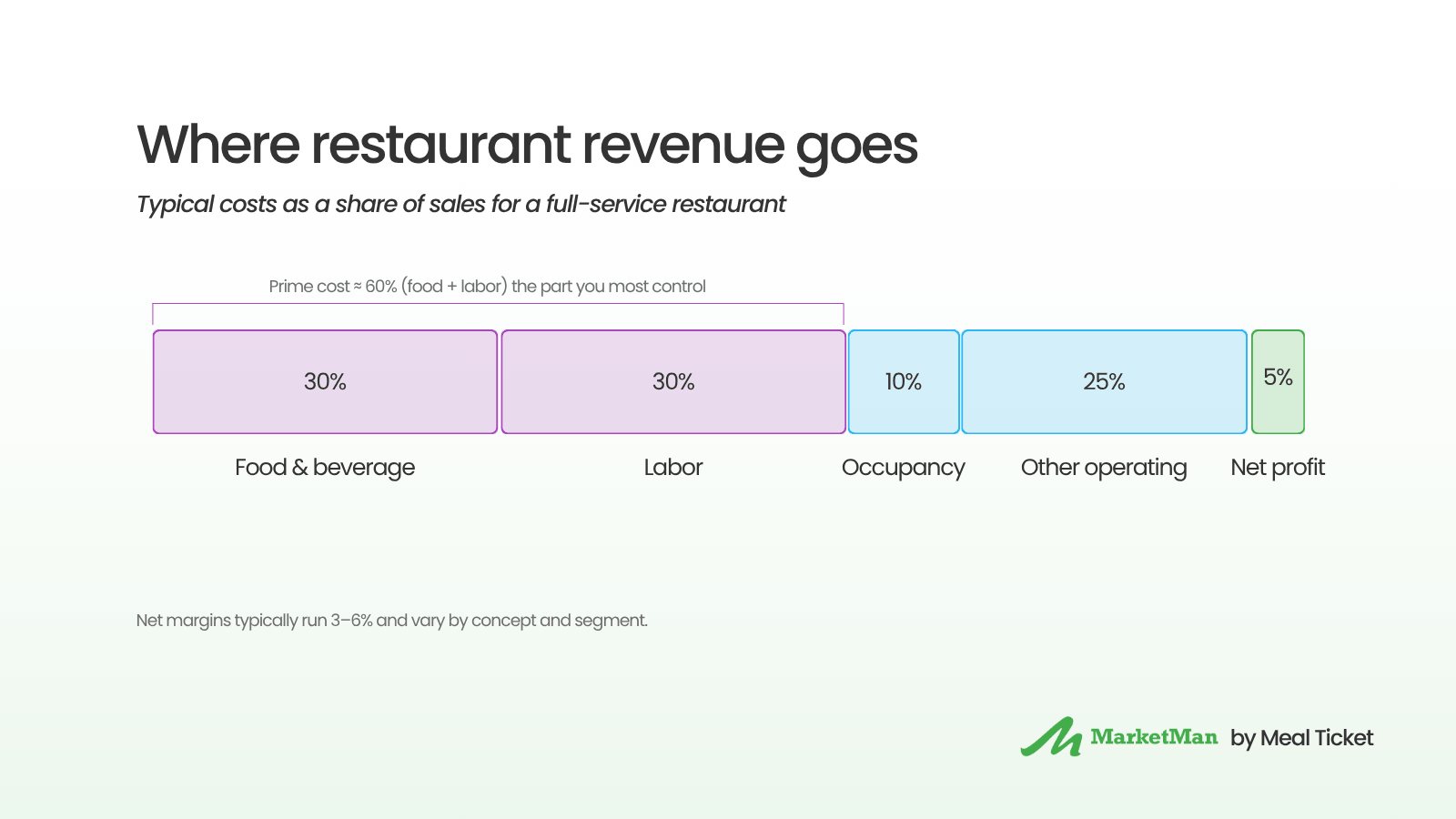
Break down where a restaurant's revenue actually goes, and it's easy to see why so little is left over:
- Food and beverage costs typically run 28–32% of revenue for a healthy operation — and that's before ingredient inflation, tariffs, or a bad delivery pushes the number higher.
- Labor is usually the single largest expense, often 30%+ of revenue once wages, benefits, and scheduling inefficiencies are factored in.
- Rent, utilities, insurance, and overhead are fixed costs that don't flex down in a slow month, even though revenue does.
Add those up, and there's rarely more than single digits left as actual profit — which is why a small shift in any one category (a supplier price increase, a few points of extra waste, a bad week of over-ordering) can be the difference between a profitable month and a break-even one.
The New Pressure on an Already Thin Number
A few forces have made 2026 a particularly difficult year to protect restaurant margins:
- Tariffs and import cost increases are pushing up prices on proteins, produce, and packaging that many operators can't easily substitute or absorb.
- A shift toward fast-casual and off-premise dining means lower average checks and thinner margins per transaction, even as fixed costs stay the same.
- Third-party delivery commissions, often 15–30% per order, quietly erode margin on a growing share of sales.
- Rising distributor and supplier prices are harder to track when the only record of what changed is a stack of invoices and a shared spreadsheet.
None of these pressures are within a single restaurant's control. What is within an operator's control is how quickly they can see a cost change and react to it — and that's where most restaurants are still working with one hand tied behind their back.
The Real Reason Margins Stay Thin: Manual, Disconnected Operations
Here's the pattern we see over and over, whether it's a 24-location chain or a single-unit concept: the tools used to manage food cost weren't built to keep up with how fast food costs actually move.
Margins erode less from any single bad decision and more from the accumulated cost of manual inventory counts, disconnected point-of-sale (POS) and accounting systems, and variance reports that show what happened last week instead of what's happening right now.
Spreadsheets Can’t Keep Up with Restaurants’ BOH
Weekly inventory counts are still one of the most common ways restaurants track food cost — a kitchen manager, GM, or bar manager physically counting stock and entering it into a spreadsheet, often taking hours to complete across a single location. Multiply that across a multi-unit group, and it's not unusual for teams to spend the better part of a day each week on a task that produces a number that's already out of date by the time it's compiled.
Variance Reports Arrive Too Late to Matter
Even operators who do get a weekly food-cost variance report often run into the same wall: the report tells them a location was over budget, but not why, and not in time to fix it before the next delivery arrives. Managers end up bonused or evaluated on a number they have no real tools to influence in real time.
Systems That Don't Talk to Each Other
POS, accounting, and inventory tools frequently operate as three separate silos. Without integration, correcting a bad order means calling a distributor's support line or digging through a portal that wasn't built with restaurant operators in mind — and the data needed to catch the next mistake before it happens simply isn't connected to begin with.
What It Actually Takes to Protect Restaurant Margins
If the core problem is visibility and speed, the fix isn't more discipline, it's better infrastructure. Here's what that looks like in practice.
Real-Time Food Cost Visibility, Not Weekly Snapshots
The gap between "what we ordered," "what we counted," and "what we should have used based on sales" is where margin quietly disappears. Closing it requires tracking actual vs. theoretical (AvT) food cost continuously, not once a week after the damage is already done.
Automating the Manual Work
Invoice scanning, automated counts, and purchasing workflows don't just save hours — they remove the human error that turns a busy Tuesday into an inventory discrepancy nobody can explain three weeks later.
Recipe-Level Cost Visibility
Knowing overall food cost percentage isn't the same as knowing which menu items are actually profitable. Recipe costing that breaks down true ingredient cost per dish is what turns a vague sense that "something's off" into a specific, fixable decision: drop an item, adjust a price, or renegotiate a supplier.
One Connected System Across Every Location
For any operation with more than one location, standardization matters as much as any single feature. A tool that only works well at one site doesn't scale, and a chain without a central view of food cost across locations is flying blind on exactly the metric that determines whether the business is actually making money.
How MarketMan Fits Into This
MarketMan has focused on exactly the problem above: AI-powered inventory management that replaces spreadsheets with automated counts, invoice scanning, purchasing, and real-time cost of goods sold (COGS) tracking, so operators can see food cost as it happens instead of a week after the fact. Today MarketMan is used by more than 15,000 restaurant locations across 55+ countries, integrating with major POS systems, accounting platforms, and food distributors to give operators one place to manage the numbers that actually move margin.
What Actually Moves the Needle for Operators Today
Whatever's happening under the corporate hood, the practical takeaway is the same one restaurant operators have been living for years: the tools that help you see food cost in real time, automate manual counting and purchasing, and know which menu items are actually making you money aren't a nice-to-have anymore. In a year where prime cost keeps climbing and the margin for error keeps shrinking, they're the difference between guessing at your numbers and actually controlling them. Done guessing at your food costs? Get a demo to see what's possible.
Häufig gestellte Fragen
What is a good profit margin for a restaurant?
Most full-service restaurants operate on a 3–5% net profit margin, while quick-service and fast-casual concepts often reach 6–9%. A net margin above 6% is generally considered strong, and anything above 10% is exceptional and usually tied to high-volume or delivery-optimized formats.
Why do restaurants have such thin profit margins?
Restaurants have thin profit margins because of their two largest costs: food and labor, together known as prime cost. Most operators still track them with manual counts and spreadsheets that can't keep pace with how quickly ingredient and labor costs change.
Is MarketMan the same company as Meal Ticket?
Yes, MarketMan is part of Meal Ticket, the parent company. Nothing changes about your MarketMan account or how you use it; Meal Ticket is simply the name for the parent company behind MarketMan.
What's the difference between MarketMan and TrackMax+?
MarketMan is inventory and food-cost software built for restaurant operators. TrackMax+, also in the Meal Ticket family, is a separate platform built for food distributors. If you're an operator, MarketMan is the one you'll use.
How can restaurants improve their profit margins?
The most effective levers are real-time visibility into actual vs. theoretical (AvT) food cost, automated inventory counts and purchasing to eliminate manual error, recipe-level cost tracking to identify which menu items are actually profitable, and centralized reporting across locations for multi-unit operations.
Mitwirkende
Schließen Sie sich über 18.000 Restaurants an und erhalten Sie die heißesten Restauranttipps direkt in Ihren Posteingang.
Das könnte Sie auch interessieren

Bereit zum Start?
Sprechen Sie noch heute mit einem Restaurantexperten und erfahren Sie, wie MarketMan Ihrem Unternehmen helfen kann