
.svg)


Restaurant Prime Cost: The One Number That Decides Whether You Make Money
Learn how restaurant prime cost, the sum of food and labor, decides whether you actually make money. Discover the formula, the 55–65% benchmark by restaurant type, and how tools like MarketMan help operators track it weekly and protect margins.
Restaurant prime cost is the sum of your cost of goods sold (food and beverage) and your total labor cost, including wages, taxes, and benefits. It's the single largest chunk of controllable spending in your restaurant, and most operators should keep it between 55% and 65% of total sales. Track it weekly, and you control your margins. Ignore it, and you are running your restaurant on a gut feeling.
That last part matters more than any benchmark. You can focus primarily on food cost and still lose money if labor quietly creeps up. Prime cost is the number that catches both.
Key takeaways
- Prime cost = COGS + total labor. It combines your two biggest controllable expenses into one figure.
- The overall target is 55% to 65% of sales: about 60% to 65% for full-service and 55% to 60% for quick-service.
- Food and labor costs have climbed roughly 35% since 2019, which is why watching them separately is no longer enough.
- Weekly tracking beats monthly. A monthly number tells you what already happened. A weekly number lets you fix it before payroll and the next food order lock in.
- Prime cost is controllable. Rent is fixed. Prime cost is where you actually move the needle on profit.
Restaurant Prime Cost Calculator
Know the one number that decides whether your month made money. Enter your food and labor costs and see your prime cost in dollars, as a percentage of sales, and how it compares to healthy industry benchmarks.
What is restaurant prime cost?
Restaurant prime cost is your total cost of goods sold plus your total labor cost, expressed as both a dollar figure and a percentage of sales. COGS covers everything you buy to make and pour what you sell: proteins, produce, dry goods, beer, wine, and liquor. Labor covers hourly wages, salaried management, payroll taxes, and benefits.
Add those two together and you have the biggest number you can actually do something about. Occupancy costs like rent and insurance are largely fixed once you sign the lease. Prime cost is different. Every portion, every schedule, every vendor invoice moves it.
That is why seasoned operators, lenders, and buyers judge a restaurant on prime cost rather than food cost alone. It answers a simple question: of every dollar that comes in, how much is spent before you have covered a single fixed bill?
The prime cost formula
The prime cost formula is straightforward:
Prime Cost = Cost of Goods Sold + Total Labor Cost
To turn that into a percentage, which is how you actually benchmark it:
Prime Cost Percentage = (COGS + Total Labor Cost) / Total Sales x 100
A worked example makes it concrete. Say your restaurant does $100,000 in sales for the period. You spent $30,000 on food and beverage and $28,000 on labor.
- COGS: $30,000
- Labor: $28,000
- Prime cost: $58,000
- Prime cost percentage: $58,000 / $100,000 = 58%
At 58%, that restaurant sits comfortably inside the healthy range. It has 42 cents on every dollar left to cover rent, utilities, marketing, and profit. Push prime cost to 70%, and that cushion shrinks to 30 cents, which usually is not enough to leave anything for the owner.
One caution on the labor line: include everything. Payroll taxes and benefits are real money, and leaving them out makes your prime cost look better than it is. The number only protects you if it tells the truth.
What is a good prime cost percentage?
A good restaurant prime cost percentage falls between 55% and 65% of total sales, and the right target depends on your format. Full-service concepts generally aim for 60% to 65%. Quick-service and counter-service restaurants should aim a little lower, in the 55% to 60% range, because simpler menus and faster throughput keep both food and labor leaner.
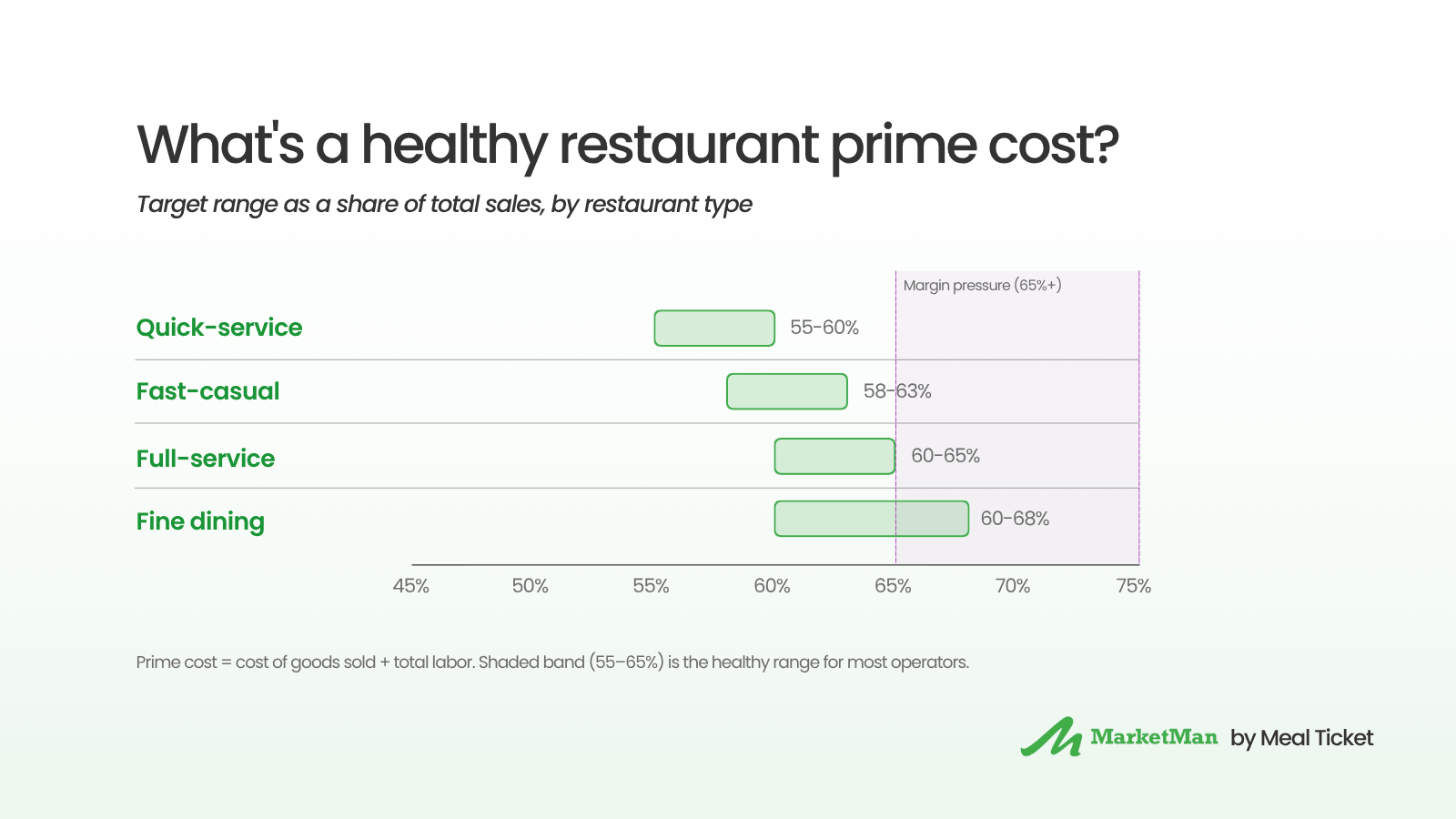
The right target depends on your format:
- Quick-service restaurants: 55% to 60%. Standardized recipes and higher volume keep costs down.
- Full-service restaurants: 60% to 65%. More menu complexity and table service push labor up.
- Fine dining: often 60% to 68%. Premium ingredients raise food cost, and skilled kitchen and floor staff raise labor.
These are ranges, not laws. A high-volume pizza shop and a white-tablecloth steakhouse have very different cost structures, and both can be profitable. What matters is knowing your target for your format and watching the trend. A prime cost creeping from 60% to 64% over three months is a warning worth acting on, even though 64% is still technically inside the range.
Why does prime cost matter more than food cost alone?
Prime cost matters more than food cost alone because it catches problems that food cost hides. You can run a textbook 30% food cost percentage and still bleed money if your labor cost has drifted to 38%. Food cost only shows you half the picture. Prime cost shows you the half that actually determines whether you profit.
The pressure is real. According to the National Restaurant Association, both food and labor costs have risen roughly 35% since 2019. Minimum wage increases, tighter labor markets, and reduced scheduling flexibility have made restaurant labor cost harder to move than it used to be. When one of your two biggest costs gets stickier, managing them as a single number becomes the only way to stay ahead.
Prime cost also connects directly to survival math. Your break-even point is essentially a question of how much sales you need to cover prime cost plus fixed costs. Lower your prime cost by even two points, and your break-even sales drop with it. That is margin you keep without raising a single menu price.
How to calculate prime cost step by step
Calculating prime cost takes five steps and about the same effort as a solid weekly inventory count.
Step 1: Pin down your period
Pick a consistent window. Most operators use a week, though a 4-week accounting period works too. The point is to compare apples to apples every time.
Step 2: Calculate cost of goods sold
Use the standard COGS formula: beginning inventory, plus purchases, minus ending inventory. This is where an accurate count earns its keep. Skip it, and every downstream number is guesswork.
Step 3: Total your labor
Add up hourly wages, salaried pay for the period, payroll taxes, and benefits. Do not leave out the back office. A manager's salary is labor even if they never touch a saute pan.
Step 4: Add them together
COGS plus labor equals your prime cost in dollars.
Step 5: Convert to a percentage
Divide prime cost by total sales for the same period and multiply by 100. Now you have a number you can benchmark against your target and, more importantly, against last week.
The math is not hard. The discipline of doing it every week is where most restaurants fall down, usually because pulling the numbers by hand across a POS, a payroll system, and a stack of vendor invoices eats an afternoon nobody has.
How to lower your restaurant prime cost
Lowering prime cost comes down to attacking food and labor without hurting the guest experience. A few of the highest-impact moves:
- Track actual versus theoretical food cost. The gap between what your recipes should have cost and what you actually spent is where waste, over-portioning, and theft hide. Closing it protects margin without touching a menu price.
- Engineer the menu. Push high-margin items and rework or retire the low-margin ones that tie up prep time and inventory.
- Standardize portions and recipes. Consistent portioning is one of the fastest ways to pull food cost back in line.
- Schedule to demand. Match labor to your real sales patterns using historical data instead of scheduling the way you always have.
- Tighten purchasing. Compare vendor pricing, buy seasonally, and consolidate orders to cut both cost and the hours spent managing them.
None of these are one-time fixes. Prime cost is a number you manage continuously, which is exactly why weekly visibility matters so much.
Why weekly prime cost tracking beats monthly
Weekly prime cost tracking beats monthly because a monthly number arrives too late to change anything. By the time you close the books on a bad month, four weeks of over-ordering and overstaffing are already spent. A weekly number lets you catch a labor spike or a food cost jump while you can still adjust the next schedule and the next order.
Weekly tracking is the minimum standard for operators who want real control. It turns prime cost from a report you read into a lever you pull. The catch is time. Building the number by hand every week means reconciling POS sales, payroll, inventory counts, and invoices, which is exactly the kind of manual work that never gets done consistently.
This is where the right system pays for itself. MarketMan, the AI-powered restaurant inventory management platform, automates the inventory and purchasing side of the equation. It processes invoices 3x faster, connects directly to distributors like Sysco and US Foods, and helps operators lower food costs by 5%. When your COGS number builds itself from real inventory and invoice data, a weekly prime cost check stops being a chore and starts being a habit.
Frequently asked questions
What is included in restaurant prime cost?
Restaurant prime cost includes two categories: cost of goods sold and total labor. COGS covers all food and beverage you purchase to make what you sell. Labor covers hourly wages, salaried pay, payroll taxes, and benefits. Fixed costs like rent, utilities, and insurance are not part of prime cost, because they are not controllable in the same way.
What is a good prime cost for a restaurant?
A good prime cost is 55% to 65% of total sales overall: about 60% to 65% for full-service restaurants and 55% to 60% for quick-service. Fine dining often runs 60% to 68% because premium ingredients and skilled staff raise both sides. The exact target depends on your format, so benchmark against restaurants like yours, not the industry as a whole.
How do you calculate prime cost percentage?
Add your cost of goods sold to your total labor cost, divide by total sales for the same period, and multiply by 100. For example, $30,000 in COGS plus $28,000 in labor on $100,000 in sales gives a prime cost of $58,000, or 58%. Use the same time period for all three inputs so the percentage is accurate.
Is prime cost the same as food cost?
No. Food cost measures only your cost of goods sold as a percentage of sales. Prime cost combines food cost and labor cost into one figure. A restaurant can have a healthy food cost and an unhealthy prime cost if labor is too high, which is why prime cost gives you a fuller picture of profitability.
How often should I calculate prime cost?
Calculate prime cost weekly. A weekly number lets you spot and correct problems in food or labor before the next order and schedule lock them in. Monthly tracking is better than nothing, but it reports problems after the money is already spent. For a broader view of what to watch, see 12 Simple Metrics Restaurants Can Use to Increase Revenue.
Why is my prime cost too high?
A prime cost above your target usually comes from one of two places: food cost or labor. On the food side, look for over-portioning, waste, spoilage, and vendor price increases you have not passed through. On the labor side, look for overstaffing relative to sales and schedules that do not match demand. Tracking both weekly is the fastest way to find which one is the culprit.
Take control of the number that matters most
Prime cost is the clearest signal you have of whether your restaurant is actually making money. Know your target, calculate it every week, and treat any upward drift as a problem to solve now rather than a surprise to explain later.
Doing that by hand is possible. Doing it consistently, week after week, across every location, is where most operators need help. MarketMan gives you real-time visibility into the food and inventory side of prime cost so the number is always current and always accurate. Get a demo of MarketMan and put your prime cost on autopilot.
Mitwirkende
Schließen Sie sich über 18.000 Restaurants an und erhalten Sie die heißesten Restauranttipps direkt in Ihren Posteingang.
Das könnte Sie auch interessieren

Bereit zum Start?
Sprechen Sie noch heute mit einem Restaurantexperten und erfahren Sie, wie MarketMan Ihrem Unternehmen helfen kann