
.svg)
Three-Way Match for Restaurants: Catch Invoice Errors Before You Pay
Shorts, subs, and surprise price changes slip through when nobody checks the invoice against the delivery. Here's how to run a three-way match in a restaurant, starting at the back door.
A three-way match compares three documents before you pay a vendor: the purchase order (what you ordered), the receiving record (what actually came off the truck), and the invoice (what you're being billed). If the three line up, the invoice gets approved. If something's off, payment waits until the vendor fixes it, usually with a credit memo.
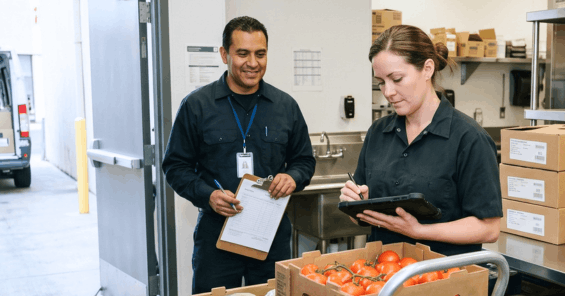
At a big company, a purchasing team and an AP department split this work across desks. Most restaurants have neither, so the check has to start with whoever signs for the delivery. If that person signs and walks away, the match never really happens, and the invoice gets paid as written.
Key takeaways
- A three-way match checks the PO, the receiving record, and the invoice against each other before payment.
- Most restaurant mismatches start at the back door, so that's where the check has to start too.
- The match is only as good as receiving. If nobody checks the delivery, there's nothing to match against.
- No POs? A two-way match between what you received and what you were billed still catches a lot.
- Keeping orders, receiving, and invoices in one system makes discrepancies much easier to spot.
Restaurant Chart of Accounts Template
Build your restaurant's books on a foundation that actually works. This free, fully editable Restaurant Chart of Accounts Template organizes every account by category and number, so your P&L and balance sheet tell you where the money really goes.

What is a three-way match in a restaurant?
A three-way match is an accounts payable check. Before an invoice gets paid, someone lines it up against two other records: the order you placed and what actually came in the back door. In restaurant terms, the three documents are:
- The purchase order. Your order to the vendor, with items, quantities, and expected prices. It might come from an order guide, a vendor portal, or your inventory system.
- The receiving record. What showed up, as counted and checked at the door, including anything shorted, substituted, or rejected.
- The invoice. What the vendor is billing you for.
Skip the receiving record and you're comparing two pieces of paper that were both written before the truck pulled up. Neither one knows what actually made it into your walk-in.
Why do restaurant invoices go wrong?
Most restaurant go wrong due to honest mistakes. Distributors move a huge number of cases every day, and small errors come with the territory. Here's what they look like in a kitchen, and which record catches each one:
None of these is dramatic on its own. But say a location absorbs $30 a week in overcharges and missed credits. That's $1,560 a year from one store, before you multiply it across locations.
The back-office side has its own traps, like invoices that sit in a pile until month-end. We cover those in 7 restaurant invoice management mistakes.
How do you do a three-way match, step by step?
- Write the order down. Record items, quantities, and the price you expect to pay.
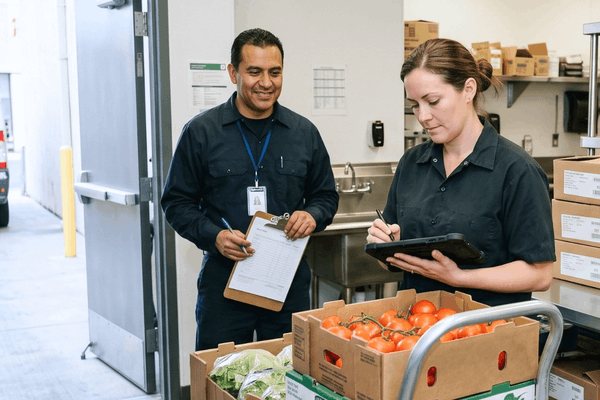
- Check the delivery before the driver leaves. Count against the order, weigh anything sold by the pound, and check temperatures and quality. Our food receiving procedure guide covers the full check.
- Mark up the driver's copy. Shorts, subs, and refusals go on the paper with the driver's signature. If it isn't written down, it didn't happen.
- Line up the invoice. Compare item, quantity, unit price, and line total against both the order and what you received.
- Approve or hold. Clean invoices go to payment. Anything else waits for a credit memo or a corrected invoice.
Decide ahead of time what's too small to chase. A few cents of rounding on a produce invoice isn't worth a phone call. A wrong case price on something you buy every week is.
What should you do when the invoice doesn't match?
Hold the invoice, document the difference, and get it resolved before you pay. How you resolve it depends on the problem:
- Short or rejected product: Request a credit memo that references the invoice number, and keep a running list of credits owed until each one shows up.
- Price difference: Compare the invoice to your quote, contract, or order guide price, then call your rep. Sometimes it's a mistake. Sometimes it's a price increase nobody told you about, which you want to know either way.
- Substitution: Decide whether to accept it at the invoiced price. If it becomes permanent, update the item in your system so your recipe costs stay right.
Track discrepancies by vendor. One-off mistakes happen. The same vendor shorting you every other week is a conversation, and our list of questions to ask your food suppliers is a good place to start it. For the bigger picture, see our guide to restaurant vendor management.
Can you match invoices without purchase orders?
Yes. It's a two-way match: compare the invoice to your receiving record, then check prices against your last order or order guide. Plenty of independent restaurants order by phone or text, so this is where many of them start.
It still catches shorts, rejections, and catch-weight gaps. What it can't reliably catch is being billed for something you never ordered, or at a price different from the one you agreed to. If you buy from multiple vendors, that gap gets bigger, and POs start to pay for themselves.
Who should own the three-way match?
Split the three-way match between two people when you can. The kitchen manager or sous chef who receives the delivery owns the receiving record. The GM, bookkeeper, or accountant owns the match and the approval. Keeping ordering, receiving, and payment approval from all resting on one person is a basic control, and it protects the person doing the work as much as the business. Our guide to restaurant bookkeeping covers how this fits into the rest of your AP process.
How does software automate three-way matching?
The manual version works, but it depends on paper surviving a shift in the kitchen and on someone having time to compare it line by line. Software removes most of that. When the order, the receiving record, and the invoice all live in the same system, the comparison doesn't depend on someone finding the right clipboard.
In MarketMan, you place orders from the platform, log inventory through the system, and capture invoices with AI invoice scanning. Because all three live on one platform, it's easier to spot what doesn't line up before an invoice is approved. The price you actually paid then flows into your inventory values, COGS, and recipe costs.
If your team signs for deliveries and pays whatever the invoice says, get a demo and see how purchasing and receiving and AP automation work together.
Frequently asked questions about three-way match for restaurants
What is a three-way match in accounts payable?
A three-way check match in accounts payable is a check you run before paying a vendor: the invoice has to agree with both the order you placed and the record of what you received. Any line that doesn't agree on quantity or price waits until the vendor corrects it.
What's the difference between a two-way and a three-way match?
A two-way match checks the invoice against the purchase order. A three-way match also brings in what was received at the door, the only record that shows whether the product really arrived. For restaurants, that's where shorts, refusals, and weight differences come to light.
What is a credit memo?
A credit memo is a document from the vendor that reduces what you owe on an invoice, for example for a shorted case, a rejected item, or a pricing error. Keep track of credits you've requested until they show up on your account.
Do small restaurants need a three-way match?
Even a single location benefits from checking deliveries against invoices. If you don't use purchase orders, start with a two-way match between what you received and what you were billed, and compare prices to your last order.
Who should do the three-way match in a restaurant?
Ideally two people: whoever receives the delivery records what arrived, and a GM, bookkeeper, or accountant matches and approves the invoice. Splitting the roles is a simple control against errors and fraud.
Mitwirkende
Schließen Sie sich über 18.000 Restaurants an und erhalten Sie die heißesten Restauranttipps direkt in Ihren Posteingang.
Das könnte Sie auch interessieren

Bereit zum Start?
Sprechen Sie noch heute mit einem Restaurantexperten und erfahren Sie, wie MarketMan Ihrem Unternehmen helfen kann