
.svg)
Restaurant Vendor Management: Simplify Ordering & Cut Costs
Entdecken Sie, wie Restaurants mit MarketMan ihr Lieferantenmanagement optimieren können. Lernen Sie Strategien kennen, um Kosten zu senken, Rechnungen zu automatisieren und Lieferantenpartnerschaften zu stärken.
Warum das Lieferantenmanagement die Rentabilität im Jahr 2025 bestimmt
Restaurants stehen und fallen mit ihren Margen, und im Jahr 2025 sind diese Margen so gering wie nie zuvor. Die Inflation treibt die Kosten für Proteine, Obst und Gemüse sowie Trockenwaren weiter in die Höhe, sodass den Betreibern kaum Spielraum für Fehler bleibt.
Gleichzeitig haben sich Lieferantenzahlungen von einer Backoffice-Aufgabe zu einem strategischen Vorteil entwickelt. Verzögerte oder unregelmäßige Zahlungen können die Beziehungen zu Lieferanten belasten, Lieferungen stören und die Vorteile von Skonti für vorzeitige Zahlungen zunichte machen. Die Funktion „Lieferantenzahlungen” von MarketMan automatisiert Genehmigungen, plant Zahlungen und synchronisiert Daten direkt mit Buchhaltungssystemen, sodass Betreiber in Echtzeit sehen können, was wann an wen zu zahlen ist. Lieferanten werden schneller und zuverlässiger bezahlt, während Restaurants von stärkeren Partnerschaften, weniger Streitigkeiten und einem verbesserten Cashflow profitieren. In einem von Volatilität geprägten Markt kann eine solche Automatisierung den Unterschied zwischen stetigem Wachstum und Margenverfall ausmachen.
Der Arbeitskräftemangel erhöht den Druck zusätzlich und zwingt Köche und Manager dazu, mehrere Aufgaben gleichzeitig zu bewältigen, während die Kunden weiterhin eine gleichbleibende Qualität und Preisgestaltung erwarten, unabhängig davon, wie oft sie essen gehen. Traditionell haben sich die Betreiber auf die Kontrolle der Lebensmittel- und Arbeitskosten konzentriert. In der heutigen Wirtschaft hat sich jedoch das Lieferantenmanagement als dritte Säule der Rentabilität herauskristallisiert.
Warum? Weil Ineffizienzen, Fehler und verpasste Chancen in Lieferantenbeziehungen jedes Jahr still und leise Tausende von Dollar verschlingen – Verluste, die nicht einfach durch eine Erhöhung der Menüpreise ausgeglichen werden können, ohne die Loyalität der Gäste zu gefährden. Deloitte schätzt, dass eine schlechte Lieferantenüberwachung für 5 bis 10 % der verlorenen Ausgaben in allen Branchen verantwortlich ist. In Restaurants, wo die Lebensmittelkosten durchschnittlich 28 bis 35 % des Umsatzes ausmachen, entspricht dies jährlich Zehntausenden an versteckten Verlusten.
Die während der COVID-19-Pandemie erstmals zutage getretenen Störungen in der Lieferkette wirken sich aufgrund klimabedingter Engpässe und globaler Frachtverzögerungen weiterhin auf die gesamte Branche aus. Für Restaurants ist das Lieferantenmanagement nicht mehr nur eine betriebliche Notwendigkeit, sondern eine strategische Fähigkeit, die darüber entscheidet, ob Sie effizient skalieren, Ihre Margen schützen und die von Ihren Gästen erwartete Konsistenz liefern können.
Checkliste für die Öffnung und Schließung der Küche im Back-of-House-Bereich
Sorgen Sie mit unserer kostenlosen Checkliste für die Öffnung und Schließung Ihrer Küche für Konsistenz und Effizienz in Ihrem Küchenbetrieb. Bereiten Sie Ihr Team jeden Tag auf den Erfolg vor.
The Hidden Costs of Poor Vendor Oversight
When most operators think about vendor management, they focus on price per case or carton. But the true costs go much deeper. These “hidden” leaks are where restaurants bleed profitability without realizing it:
- Missed rebates and discounts: Vendors often provide rebates for consistent orders, volume thresholds, or seasonal promotions. Without systems to track them, restaurants forfeit thousands in unclaimed discounts.
- Contract leakage: Contracts may guarantee specific pricing, but substitutions and incremental increases slip through unnoticed. Multiply this across hundreds of invoices, and the losses are staggering.
- Vendor creep and duplicate SKUs: When different managers at different locations order independently, the vendor lists balloons. Suddenly, five different suppliers are delivering lettuce, each at different prices. This dilutes buying power and makes consistency impossible.
- Invoice errors: Studies suggest 1 in 4 invoices contains errors. These can be duplicate charges, wrong quantities, or items not received. Without automation, most of these go undetected.
- Operational drag: The manual effort required to check invoices, reconcile numbers, and chase corrections eats up valuable hours. For a multi-unit group, this can equate to hundreds of hours monthly, time that could otherwise be spent training staff, improving guest experience, or developing menus.
The result is a silent erosion of profitability. Without visibility, operators are effectively negotiating blind.
Why Traditional Vendor Management Is Broken
Despite these challenges, many restaurants still rely on outdated systems:
- Phone calls and texts to suppliers; no audit trail, no way to track commitments.
- Spreadsheets that require manual updates and are prone to human error.
- Paper invoices stacked in offices, easy to lose and impossible to analyze at scale.
- Emails scattered across managers, creating fragmented communication.
For a single-unit independent, this may feel manageable for a while. For a 10-unit chain or a growing group, it’s chaos. Without a vendor management system, each location becomes its own island and corporate leaders have no way of knowing whether they’re overpaying or missing opportunities to consolidate spend.
This broken model explains why vendor management often feels like a constant fire drill; reacting to shortages, substitutions, or disputes instead of preventing them.
MarketMan isn’t just solving operational headaches, it’s transforming how restaurants think about cost control and supplier partnerships. The results speak for themselves.
Real-World Results: How Operators Win with MarketMan
The impact of smarter vendors and inventory management isn’t theoretical, it’s measurable. Across concepts of every size, MarketMan helps restaurants regain control of their costs, time, and visibility. Here are a few examples:
Café Crêpe – 85% reduction in inventory time.
Café Crêpe streamlined its back-of-house operations by integrating MarketMan with its POS system. Inventory counts that once ate up hours now take a fraction of the time, an 85% reduction—freeing managers to focus more on guests and less on spreadsheets.
Taco Del Mar – 3% lower COGS.
For this fast-casual favorite, small margins add up quickly. By surfacing supplier price variances and standardizing purchasing through MarketMan, Taco Del Mar reduced its cost of goods sold by 3%, creating measurable savings across multiple units.
Bakery Lorraine – COGS reduction from 30%. Managing several locations plus a commissary meant Bakery Lorraine struggled with consistency and cost control. MarketMan brought clarity by unifying purchasing and tracking across outlets, helping the group cut COGS from 30% while scaling growth.
ATFC Ltd. – 80% less time on inventory. This hospitality group, operating more than 20 sites, was losing hours each week to manual counts. MarketMan’s digital inventory tools reduced the workload by 80%, giving leadership better visibility while reclaiming time for front-line service.
Ashley Mac’s – 60% reduction in counting time.
With multiple restaurants in operation, Ashley Mac’s needed efficiency without sacrificing accuracy. MarketMan simplified counts across every site, reducing inventory time by 60% and allowing teams to redirect energy toward service and sales.
What Effective Vendor Management Looks Like in 2025
Today’s most successful restaurants are redefining vendor management, trading spreadsheets and email chains for centralized, automated systems that drive visibility, accuracy, and control. Here’s what effective restaurant vendor management looks like when powered by technology like MarketMan:
1. Centralized Visibility Across All Vendors
A modern restaurant vendor management system consolidates every supplier into one dashboard. Operators instantly spot duplicate vendors, inconsistent pricing, or out-of-date terms. With MarketMan, multi-location groups gain full visibility across purchasing operations—no more guesswork or data silos.
2. Real-Time Price Tracking
Instead of relying on memory or manual checks, operators can track supplier pricing in real time. MarketMan automatically flags price fluctuations across vendors, helping restaurants identify increases, spot trends, and negotiate better deals. Over time, this visibility protects margins and builds trust with reliable suppliers.
3. Automated Invoicing and Error Prevention
Manual invoice entry is where most mistakes happen. With AI-powered invoice scanning, MarketMan eliminates manual input, detects pricing discrepancies, and syncs invoices directly with accounting platforms. This not only saves hours of back-office work but also prevents costly errors before they impact COGS.
4. Price and Process Standardization Across Locations
Consistency drives profitability. MarketMan helps restaurants standardize vendor pricing and purchasing processes across all units. Corporate teams can enforce negotiated rates, approve exceptions, and monitor compliance—ensuring every dollar spent aligns with company-wide cost goals.
5. Predictive Ordering and Collaborative Forecasting
With demand forecasting and supplier communication, MarketMan enables operators to plan smarter. Restaurants can share predictive data with vendors to secure bulk discounts, minimize stockouts, and optimize delivery schedules, all while reducing waste and over-ordering.
With MarketMan, vendor management isn’t a manual checklist—it’s a connected, automated ecosystem. Operators gain real-time visibility, automated accuracy, and data-driven control over every supplier relationship, transforming what used to be back-office chaos into a profit-driving system.
Unlike accounting or POS-first systems, MarketMan is built from the kitchen out. It’s intuitive, data-driven, and designed for operators who need fast answers, not spreadsheets. MarketMan takes an operator-first approach, making vendor management intuitive and actionable for chefs, managers, and owners alike.
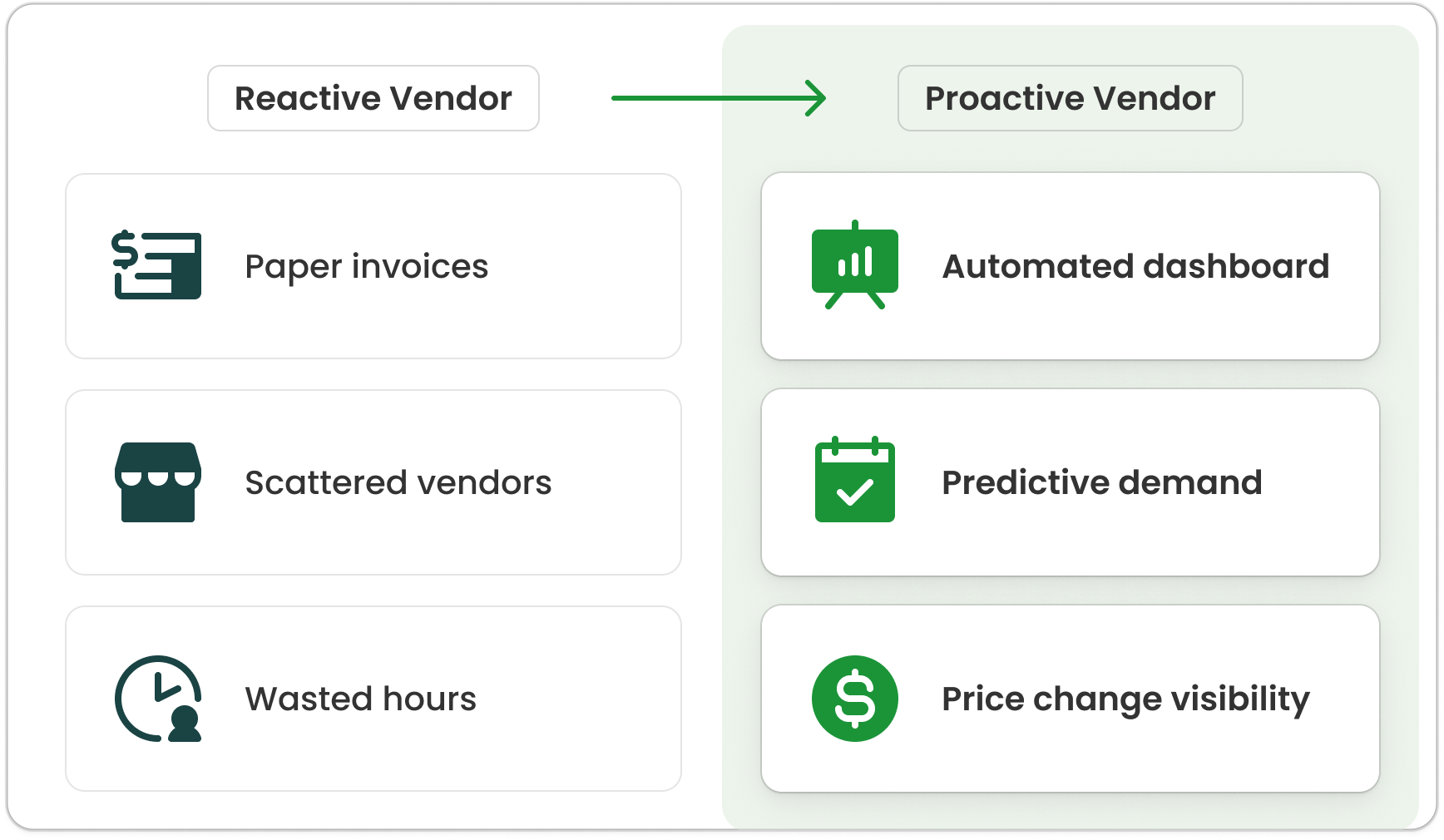
The Future of Vendor Management: From Reactive to Proactive
The future of restaurant vendor management isn’t just digital—it’s intelligent, connected, and operator-driven. With MarketMan’s restaurant purchasing software and order management platform, operators gain full control over every dollar spent while turning vendor management into a proactive profit strategy.
Automated Accuracy
MarketMan automatically captures and reconciles every invoice, flagging discrepancies the moment they appear. This prevents costly errors, protects margins, and eliminates the tedious manual work that slows teams down.
Real-Time Price Visibility
Fluctuating ingredient costs can crush profits if left unchecked. MarketMan’s real-time price tracking highlights changes across vendors, empowering operators to negotiate better deals and maintain consistency across all locations.
Smarter Purchasing Decisions
With centralized ordering and live inventory data, MarketMan gives restaurants the insights to order exactly what they need, when they need it. This reduces waste, strengthens supplier relationships, and ensures every order is backed by data—not guesswork.
Multi-Location Control
Whether you manage two sites or twenty, MarketMan standardizes purchasing, approvals, and vendor terms across your group. Operators get one unified system to manage all locations, guaranteeing consistency and cost transparency at scale.
Actionable Insights for Growth
From food cost trends to purchasing patterns, MarketMan turns raw data into actionable intelligence. Operators can make proactive decisions, whether adjusting menu pricing, consolidating suppliers, or planning ahead for seasonal shifts.
In short, MarketMan moves vendor management from reactive to strategic. It’s not just about keeping costs in check, it’s about empowering restaurants to grow confidently, backed by data, automation, and real-time control.
In every case, MarketMan helps operators move from reactive management to proactive control, protecting margins while empowering smarter decisions at every level.
Smarter Vendor Management, Smarter Restaurants
Restaurants that master vendor management don’t just save money — they build resilience. By digitizing invoices, consolidating vendor communication, and leveraging data for negotiations, they gain:
- Clarity – Transparent, real-time visibility into supplier behavior and costs.
- Control – Consistent pricing and standards across locations.
- Confidence – Negotiation power backed by hard data, not guesswork.
MarketMan delivers all three, turning vendor management into a profit driver instead of a problem.
Ready to take control of your margins and simplify vendor management? Book a demo with MarketMan and see how smarter purchasing turns cost control into growth.
FAQ: Vendor Management in Restaurants
What is a vendor management system for restaurants?
It’s software that centralizes supplier ordering, automates invoice processing, and provides performance analytics to improve efficiency and cost control.
How do restaurants manage multiple vendors efficiently?
The best way is to consolidate vendors into one platform. A system like MarketMan allows operators to place multi-vendor orders, digitize invoices, and track trends from a single dashboard.
What’s the best way to negotiate with suppliers?
Use data, not anecdotes. Invoice history, delivery reliability, and product quality reports give operators leverage to secure better pricing and terms.
Is vendor management software only for chains?
No. Independents save hours each week and catch costly errors, while multi-unit groups standardize costs across locations.
How does MarketMan compare to other systems?
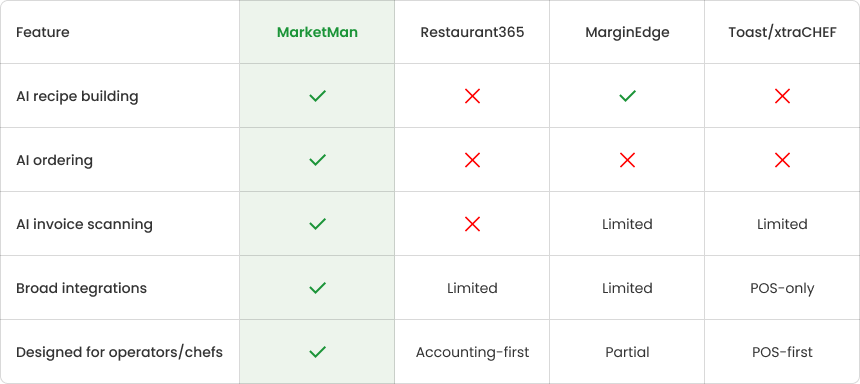
Unlike accounting-first platforms or POS-first tools, MarketMan is operator-first; designed for managers and chefs, not just accountants. Check out the side by side comparison table in this article
Other platforms help with aspects of waste reduction, but most only solve part of the problem:
How can vendor management help reduce waste?
While waste reduction is primarily achieved through inventory control and portion management, effective vendor management supports those efforts by improving ordering accuracy and consistency. When supplier pricing, delivery schedules, and product quality are standardized through a platform like MarketMan, restaurants can align purchases more closely with real demand. Fewer substitutions, more reliable quantities, and accurate cost data mean less spoilage, fewer last-minute orders, and smarter use of perishable ingredients.
Mitwirkende
Schließen Sie sich über 18.000 Restaurants an und erhalten Sie die heißesten Restauranttipps direkt in Ihren Posteingang.
Das könnte Sie auch interessieren

Bereit zum Start?
Sprechen Sie noch heute mit einem Restaurantexperten und erfahren Sie, wie MarketMan Ihrem Unternehmen helfen kann